
Lessons from my Mother

Throughout my career I have been blessed with the opportunity to build friendships and learn from mentors in the public policy world and housing industry from all corners of the United States.
But the two most important lessons I learned came from watching my mom.
My mom was born in Germany during World War II. When she was five years old, Allied forces bombed the house where she lived with her family. She was the only one who did not make it to the shelter in time. Some of her first memories are of being pulled from the rubble.
Near the end of the war, her family fled Berlin to escape the advance of Russian troops. They walked across the German countryside, avoiding roads and traveling through fields until they reached the home of a family friend. My grandmother sold family heirlooms for food and played the organ at church. My mom and her sisters took care of their little brother, avoided AWOL soldiers, and played with the aluminum chaff that fell from the sky during bombing raids.
After the war, they were moved to a Marshall Plan refugee housing camp. That community gave them something my mother had never experienced: safety, stability, and a normal life.
This is where my mom grew up. She made friends. She went to school and went on to become a librarian.
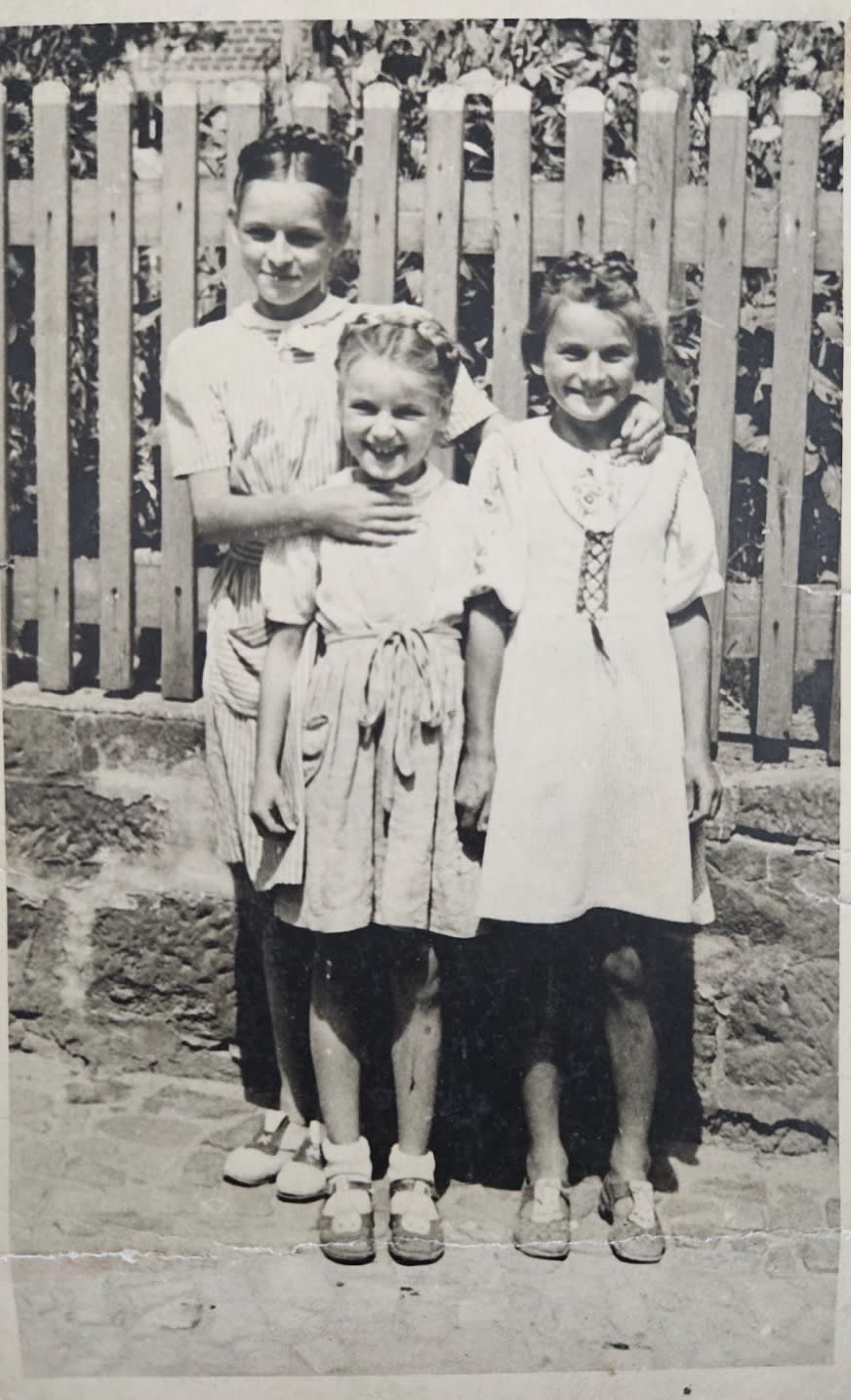
(Above: The only picture we have of my mom (middle) and her two sisters in their Marshall Plan refugee camp.)
In her mid-twenties, she immigrated to the United States to visit her sister. She fell in love with our wide open spaces and decided to stay. She taught herself English by watching the Ed Sullivan Show. She met my dad. Together they raised three kids and gave them the kind of childhood that she could only have dreamed about.
After my siblings and I left home, my mom went back to school, earned her bachelor’s degree and then a master’s degree. Afterwards, she ran a nonprofit that helped small-town entrepreneurs launch their own businesses. She eventually ended her career the same way it began – as a librarian.
My mom is kind and gentle. She suffers no fools. She has zero patience for excuses.
She is ridiculously humble and always working. Never mean and resilient as hell.
Two of the most important lessons I have ever learned came from my mom. Like most good lessons, they apply to every part of life. And like all great lessons, they always ring true.
“Life is hard. Figure it out”
I can still remember the first time my mom said this to me. I was a kid, on the cusp of middle school, drying dishes1 while my mom cleaned the kitchen. I had just finished complaining about the extra homework our teacher had given us because some of the other kids in class could not stop talking. When I finally stopped, she paused what she was doing and said: “Life is hard. Figure it out”
I would hear these six simple words a lot over the course of the next ten years and, while I may not have always liked to hear them, they would always eventually sink in. And what amazes me to this day is how my mom was able to deliver this simple message without a hint of frustration or judgement. She was simply stating a fact. Life is difficult. Things break. Plans fail. People disappoint. Markets crash. Bombs fall.
And because these things are all bound to keep happening, life leaves us with only one option: we must figure it out.
My mom’s approach was simple: If you do not know what to do, figure out a way. Read a book. Do your research. Ask someone for help. Learn from the people who have been there before. Observe the world. Ask the extra question. Pay more attention. Move through life with intention.
The answers to life’s questions may be hidden, but that does not mean they do not exist. They are everywhere, but only if we choose to look.
“Find The Good”
Life can often be hard, and for many people it is both systemically and unfairly harder than for others. My mom definitely experienced more than her fair share. But she made it abundantly clear to me that while there were many reasons to disagree or get angry with other people, there was never a reason to be unkind. There was good to be found in everyone. Even the jerks.2
That mindset feels especially important today. As our disagreements have become louder, it has become far too easy to shield ourselves from divergent points of view and simply assume the worst about those who see the world differently. It has become a lot harder to remember that being wrong is not the same thing as being bad.3
Sometimes I think that the only two things we have left in common is a talent for hearing only what we want to hear and an endless ability to never admit when we are wrong. But if my mom and her friends could spend their childhood making toys out of the stuff that bomber pilots dropped on them, then I have to believe that we also all share an innate capacity to find the good in all things and all people.
The Great Financial Crisis of 2008
At this point, I would not be surprised if some of you are wondering what color the sky is in my world, and that would be fair4. But these two simple lessons have guided me through a lot of tough moments in my career, and they were especially helpful when the global economy melted down in 2008.
I was reminded of this time recently while talking with an old friend.
We first met in 2008 during the early days of the financial crisis. I was a young vice president at Fannie Mae, trying to lead a team through the chaotic times of conservatorship. He was trying to keep his small business alive while the economy unraveled around him.
We faced different problems and worked in different parts of the economy, but we shared a common challenge of how to survive without screwing everything up.
In the early days of the crisis, we often talked about how to manage our teams and keep everyone focused through a crisis that did not seem to have an end in sight. I shared with him the story of my mom, and we decided that we would ask our teams to focus on five simple things:
1. Come to work in the morning.
2. Make a list of things to do.
3. Do those things.
4. Be kind to others.
5. Come back to work tomorrow.
It was not a perfect plan. It did not always work, but it got the job done. Fortunately, surviving a financial meltdown is a pass/fail class.
When the crisis finally ended and life got back to normal, my friend and I would joke that we had learned a set of skills to survive a “generational event” that we would never need to use again.
Then the pandemic arrived. And now we find ourselves again in another period of unprecedented political upheaval, economic uncertainty, and institutional distrust. And the best advice I can offer anyone is the same as it was twenty years ago.
Go to work. Do your job. Don’t be a jerk. Come back tomorrow.
Life is hard. Figure out. Find the good.
And don’t forget to call your mother.
My siblings will question that I was in fact drying dishes as I had a remarkable knack for disappearing outside when it came time for chores.
“Jerk” continues to be my mom’s curse word of choice. She uses it sparingly.
Over the course of human history, there have been exceptions to this rule. It is a small (but growing) list.
For the record, in my world, the sky is always blue